College Study Planner
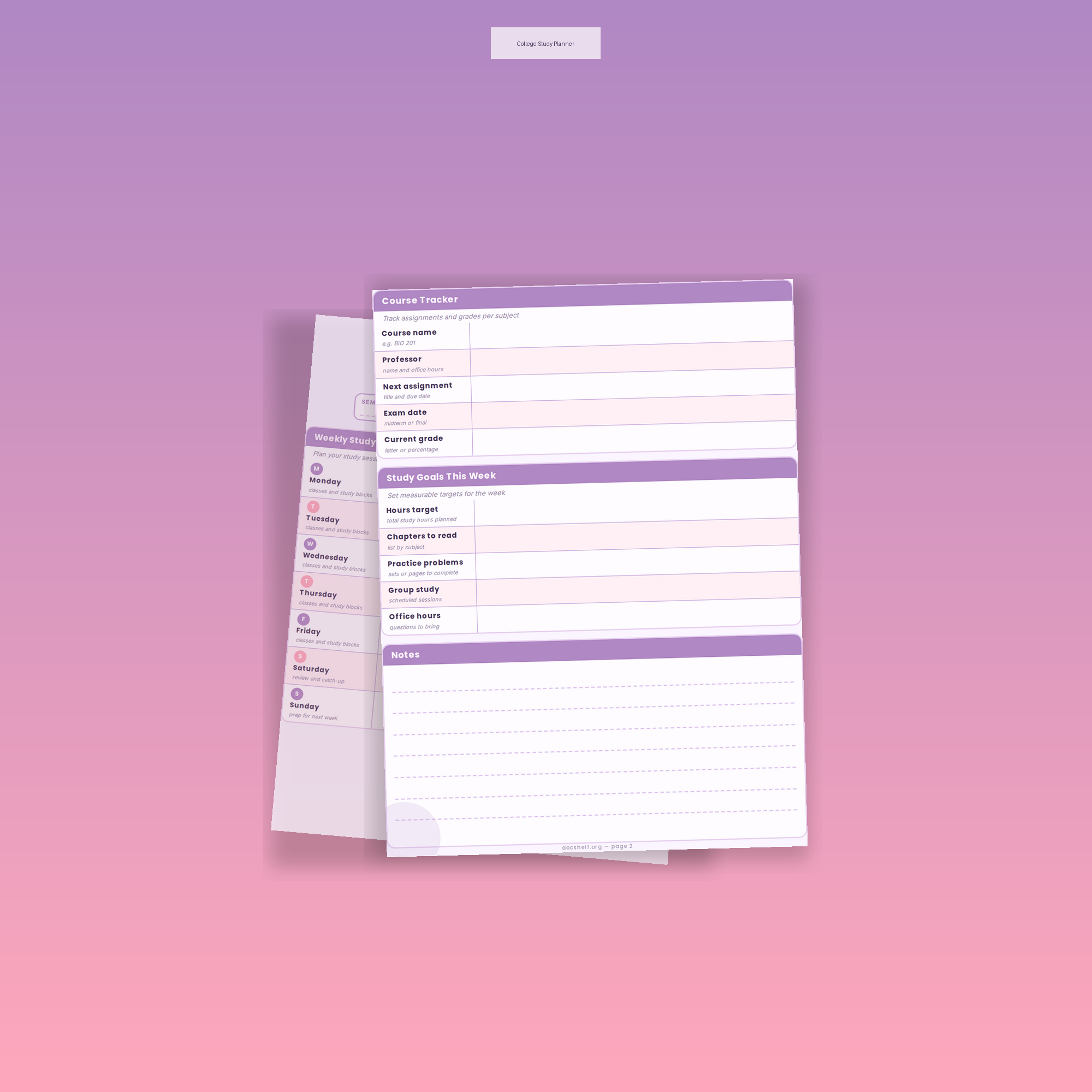
This printable college study planner printable planner is designed to help you stay organized and on track. Semester-based study planner with exam countdown and GPA tracker, designed for college students (not high school) who need semester block scheduling vs weekly layouts. What's inside: Semester Course Mapping & Credit Audit, Weekly Study Block Schedule, Exam Prep & Study Session Notes, Campus Resources & Academic Support. Perfect for anyone looking to manage their college study planner printable with a clear, structured layout that is easy to follow. Simply download, print at home or at a local print shop, and start using it right away. Compatible with standard US letter and A4 paper sizes. Also great for: college study planner, university student planner PDF, semester planner printable.
What's Included
Semester Course Mapping & Credit Audit
- List each course with its 4-digit course code, professor name, office room number, and office hours day/time
- Record the credit hour value for each course and sum total credits to confirm full-time status (usually 12+ credits)
- Write down the exact grade breakdown for each class: percentage for exams, quizzes, homework, participation, and final
- Note the attendance policy for each course — some professors drop your grade 1 full letter after 3 absences
- Mark which courses use Canvas, Blackboard, or D2L so you know where to find each syllabus and submission portal
- Identify which 2–3 courses carry the heaviest grade weight and flag them as priority subjects for the semester
- Write the textbook ISBN, edition, and whether a used copy or rental is acceptable per the syllabus
- Record each course's add/drop deadline and last day to withdraw with a W grade
Exam & Major Deadline Calendar
- Transfer all midterm and final exam dates from every syllabus into this calendar within the first 48 hours of class
- Mark paper and project due dates with the course code, exact time (11:59 PM vs. in-class), and submission method (online upload or hard copy)
- Circle any week where 2 or more exams or major deliverables land within a 3-day window — these are your crunch weeks
- Note the exam format for each midterm and final: multiple choice, essay, open-book, or in-class lab practical
- Record whether each professor allows a cheat sheet and the permitted size (e.g., one 3×5 index card, one sheet front and back)
- Flag group project check-in deadlines separately from the final group submission date
- Write the room location for each final exam — finals are often held in a different building than the regular class
- Mark any take-home exam window: date distributed and date due, with the exact turnaround hours
Weekly Study Block Schedule
- Block 2 hours of study time for every 1 credit hour per week — a 3-credit course gets 6 hours minimum outside class
- Schedule your hardest subject in your peak-focus window: identify whether you're sharpest at 8–10 AM, 2–4 PM, or 7–9 PM based on your last two weeks
- Write the specific chapter range or problem set you will cover in each block, not just the subject name
- Reserve a 90-minute slot on Sunday evening to read all syllabi for the coming week and prep materials
- Build a 30-minute review buffer before each class to skim notes from the prior lecture
- Color-code blocks by subject so you can see at a glance if one course is consuming more than 40% of your study hours
- Schedule at least one complete off day per week with zero academic work to prevent burnout across the 15-week semester
- Log the actual hours studied next to the planned hours at the end of each day to catch chronic underestimates
Reading & Assignment Progress Log
- List every assigned reading by course, textbook title, and specific page range (e.g., Campbell Biology Ch. 7, pp. 132–158)
- Mark each reading with one of three statuses: Not Started / In Progress / Done + Notes Taken
- Record whether you completed the end-of-chapter review questions — these are the most reliable exam predictors
- Log each written assignment with its word count requirement, citation style (APA 7th, MLA 9th, Chicago 17th), and submission platform
- Note which assignments allow late submission and the per-day penalty percentage (e.g., Canvas auto-deducts 10% per day)
- Flag any assignment that requires library database access (JSTOR, EBSCOhost, PubMed) so you allow time for source retrieval
- Track participation-based tasks separately — weekly discussion board posts, in-class responses, or lab write-ups have their own deadlines
- Record peer review or second-draft deadlines distinctly from initial submission deadlines for writing-intensive courses
Exam Prep & Study Session Notes
- Write the exam date at the top, then count back 7 days and divide the total material into 6 daily study portions with one review day before the exam
- Record which study method you used for each session: active recall flashcards (Anki), practice problems, past exams, or Cornell note review
- After each session, write 3 concepts you still can't explain in plain language — these go to the top of the next session's list
- Log the specific practice exam or problem set you completed with your raw score (e.g., Exam 1 from Fall 2022, scored 72/100)
- Note any professor review session date, location, and the specific topics the professor said would be emphasized
- Record office hours visits: date, questions you brought in writing, and answers given — professors often hint at exam focus areas
- Mark which chapters have formula sheets, constants, or reference tables you are allowed to bring versus those you must memorize
- Write a one-paragraph summary of each major concept in your own words — if you can't write it, you don't know it yet
GPA & Grade Calculation Tracker
- Enter each graded item with the raw score, the total possible points, and the category weight it belongs to (e.g., 88/100, quiz, 15% of grade)
- Calculate your running weighted average per course after each returned assignment using the formula: (category score × weight) summed across all categories
- Record the minimum final exam score you need to earn your target letter grade, given your current weighted average
- Track your cumulative GPA after each semester using the standard 4.0 scale: A=4.0, A-=3.7, B+=3.3, B=3.0, B-=2.7
- Note if any course is graded on a curve — record the curve amount and the adjusted score separately
- Flag courses where your current grade is below a C if your major requires a C or better to count toward degree requirements
- Write down your department's academic probation GPA threshold (commonly 2.0 cumulative) and your current distance from it
- Log financial aid GPA requirements separately — many scholarships require a 3.0 or higher each semester, not just cumulatively
Campus Resources & Academic Support
- Write the tutoring center's building name, room number, hours, and whether you need to book a slot 24 hours in advance or walk in
- Record your college writing center's drop-in hours and the maximum page count they will review per appointment
- Note the name and direct email of your assigned academic advisor and the registration window dates when you must meet to avoid a hold
- Write the library's research desk phone number and the specific database subscription your school has for your major's field
- Record your student health and counseling center's hours, whether telehealth is available, and the number of free sessions included per semester
- List the disability services office contact if you have accommodations — document the deadline to submit accommodation letters each semester (often week 1 or 2)
- Note the financial aid office's FAFSA priority deadline for next academic year, which is typically separate from the admissions deadline
- Write down your professor's email response time expectation from the syllabus — some state 48-hour reply windows, which affects how early you must email before deadlines
Frequently Asked Questions
What's included?
Semester Course Mapping & Credit Audit (8 items), Exam & Major Deadline Calendar (8 items), Weekly Study Block Schedule (8 items), Reading & Assignment Progress Log (8 items), Exam Prep & Study Session Notes (8 items), GPA & Grade Calculation Tracker (8 items), Campus Resources & Academic Support (8 items)
How do I use this printable?
After purchase, you'll receive an instant PDF download. Print at home on any printer — standard letter or A4 paper works great.
Can I print this multiple times?
Yes! Once purchased, you can print your PDF as many times as you need.